~/projects/web
The Fsektionen.se Website
Introduction
Since the start of 2024, intensifying since the start of 2025, I have been working together with members of the programming committee at my student organization rebuilding the website for our organization. I'm the primary frontend contributor, having written around 36% of the code as well as working on many project-level systems such as our API generation, server side rendering and translation loading. I've also contributed significantly to the backend, where I'm the second foremost contributor for all work done since the start of 2025. Around 6 developers work on the full stack.
The scale of collaboration has taught me many lessons in addition to learning basic React, FastAPI etc. from the stack we're working with. I think knowing how to collaborate in larger groups and giving feedback on code to other developers will be especially useful in the future.
In addition to this, a key part of my work for the committee has been participating in interviews for, and teaching the 15 or so new members who join each year how to work on our projects. This has led to a greater understanding on my part on how to communicate clearly and structure learning for people with different starting skills.
Metrics
The website handles almost 800 member accounts at present. In some specific situations, such as when new albums are released in the image gallery, when event signups open or when the digital songbook is needed during an event, peaks at over 300 concurrent connections need to be handled by the server. This is something our previous setup struggled with, but with our current stack everything works smoothly despite the single machine setup. Since we don't track our users more than this, we unfortunately don't have more detailed metrics.
Tech Stack Details
The system we replaced was an 11-year old legacy system using Ruby on Rails, which led to essentially nobody having more than a cursory understanding of how the website worked. The new site, like this portfolio, is written in TypeScript, with Next.js and React to use SSR and make it easier to develop the website. We make extensive use of tailwind and the Shadcn library for styling, and localisation is handled using i18next. The website is hosted on our own server with a FastAPI backend. We use PostgreSQL and SQLAlchemy for the ORM. The code for the frontend is available on our GitHub page, and the backend can be accessed here.
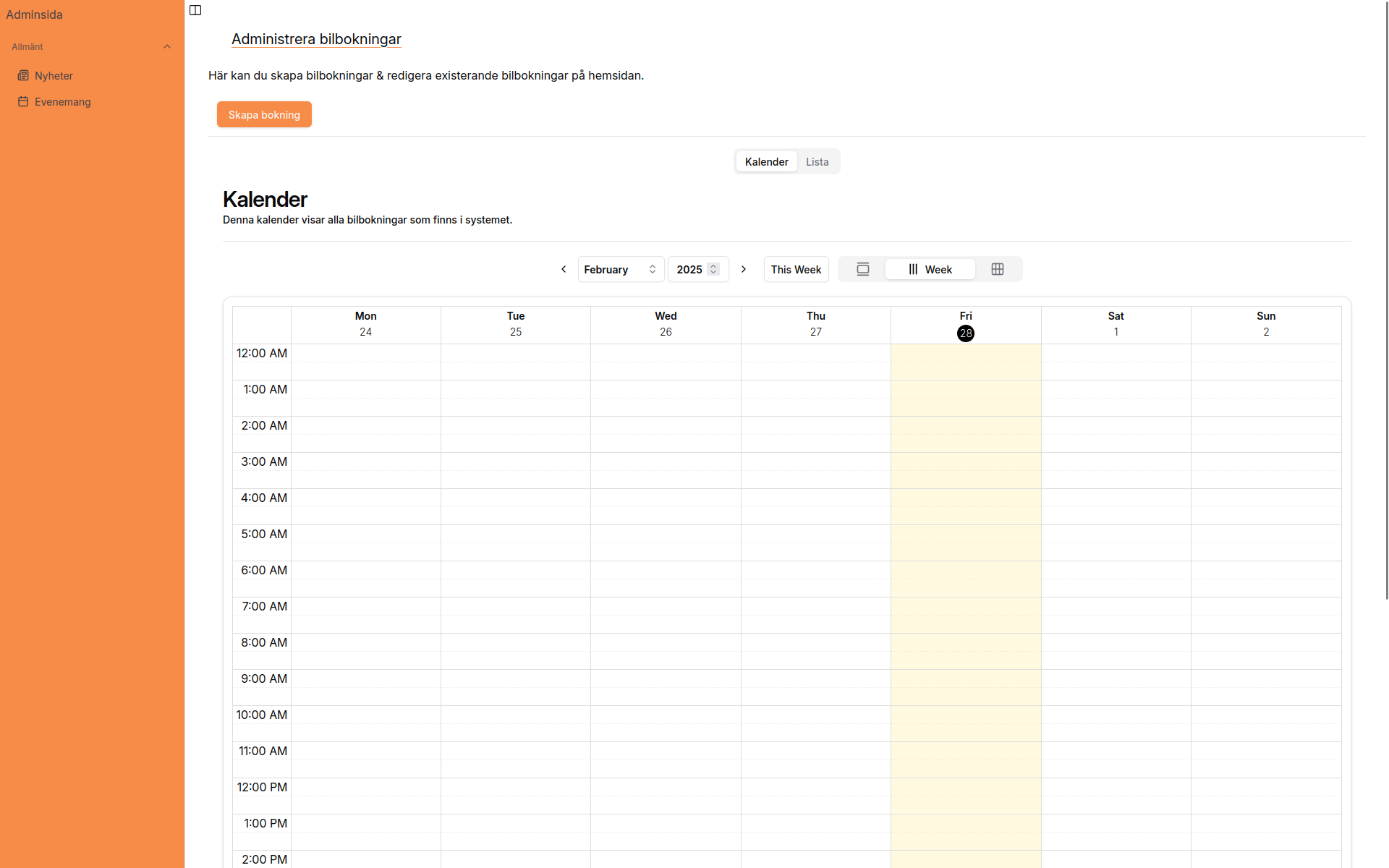
Much of my early frontend work focused on the calendar system. I ended up using a prebuilt calendar system from Robert Kinney which is built on fullcalendar-react. In hindsight, building our own variant based on fullcalendar-react would have been easier than adapting the existing component to our complex, bilingual data requirements. When building the image gallery page I had learned my lesson and opted not to use Vercel's prototype, instead creating my own view and using a custom image frame component which is reused for other pages such as the news feed.
Static Export or SSR?
A key architectural decision we revisited mid-project was whether to use static export or SSR. We originally planned to use Next.js' static export feature, but as the project progressed it became clear that this would not be feasible. Since most users prefer Swedish, and to avoid URL-based language switching, we decided to not use url-based language storage (internationalized routing), which Next.js requires for static multilingual sites. We initially implemented a workaround to hold back on the rendering of the page until the language had been initialized, but this is not ideal for SEO and is annoying for users. After further consideration, we decided to switch to using SSR with Next.js' standalone export which allowed us to keep the bilingual support using the Proxy feature (middleware). It also unified the development experience with the deployed experience, which is very helpful given our team size and the volunteer nature of the work.
Bilingual Websites with i18next
i18next is a powerful library, but configuring it properly took time, especially while evaluating rendering approaches. As a consequence, I configured i18next for both approaches, deepening my understanding of the library. For SSR, the Next.js Proxy feature (previously middleware) is used to detect the user's preferred language and set it accordingly before the page is rendered.
Lessons Learned
Since we didn't have enough time to port over all the features from the old website and the old site had many unused and abandoned features, communication with the affected parts of the organization was key. Unfortunately, since most of the work was concentrated during the summer, we had to contact and ask people sporadically and digitally. In similar future projects, I would conduct structured stakeholder interviews earlier to identify critical features.
Each year our programming committee recruits around 10-15 volunteers and brings them up to speed with our systems. Throughout this process I frequently explain what our code, often written by me, does and how the different technologies play into each other. This has prompted deeper reflection on the code and highlighted areas for deeper technical understanding.
We've had to balance giving the new members enough real work that they feel empowered and like they contribute to our projects, while still retaining some simplification to not overload people with information. We've made progress on this front this year, as we've decided to give out a mini-project using a heavily simplified version of our website which still retains the same stack and technologies.